THE WORLD SHAPERS CHAMPIONSHIP – tracks EDITION

The World Constructors Cup is a prestigious, points-based competition in Formula1 that rewards…you guessed it: the … Read more

 Luke Faddy
The World Constructors Cup is a prestigious, points-based competition in Formula1 that rewards…you guessed it: the … Read more

On an opening day that will go down in the history books as one of the … Read more

It was a Friday afternoon and I was nearing the end of a four-hour haul north. As I wound down the window the static-infused crackle of the radio was replaced by a chorus of cicadas, the air was ripe with the scent of eucalypts’ and smooth bitu- men made way for a pot-holed dirt road. Finally, that other world had been left behind. Those pesky arrows on the forecasting app weren’t perfectly aligned for the spot I had in mind, but I had a hunch it might still be ok. After dodging a few tyre-eating rocks I pulled into a clearing, breathed a sigh and did my best to shake off the driver fatigue. Two minutes later I was wandering down a bush track with board under arm, the foliage so thick it bent into a tunnel of green. Something big and reptilian scur- ried through the scrub, meanwhile, I kept my eyes peeled for the snakes that are known to tan on the track. I passed the noble fig tree and greeted it like an old friend, navigated the slippery section and welcomed the feel of mud between my toes. Eventually the portal of green gave way to a wooden platform that afforded a glorious view of the beach. Beyond the twisting dunes, three- four peaks were bending and doubling up in the shadow of a sloping headland that seemed to have the answers to the origins of the earth written in its grooves.There were only two guys out and the wind was light. With much haste I descended the wooden stairs and quickened to a trot; muddy feet wiped clean by the squelching, talcum sand. Despite the abundance of recent rains the water was clear with the mere hint of a tea-tree hue. On my first wave, two swells converged and flung me down the line like a skimming stone tossed by a discus thrower. The long drive, the recent weeks of work and a year of harsh restrictions were all forgotten as the moment commanded my full attention and my brain screamed ‘Hold on!’ I kicked off with a smile and enjoyed a long paddle back out that reacquainted me with latent muscles and allowed me to watch waves pitch and spin unridden. After a few rides I got talking to the one guy who was sharing the same peak. We traded histories and talked about our … Read more

When Albe Falzon started Tracks alongside John Witzig and David Elphick in 1970, he quickly established a routine. Once a magazine was sent to the printers, he’d grab a surfer or two and dash up the coast to shoot footage for his film project. The film didn’t have a name yet but it was already developing a theme based around living in harmony with the earth. In the magazine. a similar agenda was being pushed and came to be known as ‘The Country Soul’ movement. At the time, Stephen Cooney was the teen wunderkind regularly riding shotgun with Albe on his creative adventures up the coast. Steve’s brief was to surf as many good waves as he could in front of the cameras and help Albe capture the ‘Country Soul’ vibe he was after. “It’s impossible to count how many times I did the Pacific Highway back then,” reflects Steve with a weary chuckle. According to Steve, the long drive north was often broken up with stopovers at the little stalls various farmers and landowners would set up on the roadside outside their properties. Albe loved these interludes because they often provided an opportunity to meet the country folk and check out the rustic homes they lived in. Both the people and the places they lived in often became the subjects of Albe’s photo- graphs and footage. According to Steve Cooney, this cover was a classic example of Albe just following his muse. They’d driven past this cool old house on Angourie Road a number of times when Albe finally decided to go in and take a look. Once a little closer they were met by a charm- ing, elderly woman who welcomed the two surfy types that had just lobbed on her door- step. Steve remembers having a long chat and buying a bag of homegrown vegetables. “She was a lovely old lady and stoked to see us.” By this stage Steve had developed an intuitive understanding for the kind of photo Albe was looking for. Soon he was standing alongside the woman, posing for a shot.That’s the one, which appears on the bottom half of the cover. (The surf shot features Baddy Treloar). Stephen was also serving as Albe’s unofficial photographic apprentice, so Albe insisted he wanted a shot with the woman too. That one of Albe ran on page three of the mag with Albe clutching a … Read more

(djiraali is blood, muriyira – whale in ourYuin dhurga language.) For the last five years I have been doing field trips with the ANU School of Art & Design Environment Studio’s Balawan Elective. We go to Jigamy Farm in Eden and camp withYuin custodians, teachers and students and learn aboutYuin culture around Eden. Our ancestors survived off the land, they regulated the amount of resources that the land provided, thus maintaining balance for all to survive. In the 1800s the whalers arrived in Eden at Twofold Bay. It was business for them to kill many whales. Here, I think of all those poor whales that were slaughtered there on that beach. So this painting is about the whale’s blood that’s seeped through the sand. The Triangles – Our Yuin ancestors use linework in caves, using triangles for me represents all things connected, they represent the land markings e.g. hills, mountains, rivers, creeks, estuaries, coastlines, gullies ect. The triangles also represent the parent & child, male and female and all living things in and on the land. The triangles also represent the day/night, the stars. Amongst the lines lives the spiritual energy of our songline.

A DEEP DIVE INTO THE PHOTO ARCHIVE OF PETER ‘JOLI’ WILSON, AKA THE MEMORY MILLIONAIRE. Kelly Slater and Andy Irons on the stage after the final of the 2003 Xbox Pipeline Masters run at Pipeline Beach on the North Shore of Oahu, Hawaii. Irons not only won the Pipe Masters but also sealed the 2003 ASP World Professional Surfing Championship and the Hawaiian Triple Crown Title. Joel Parkinson (AUS) was runner up to Irons while Phil MacDonald (AUS) was third and Slater finished in fourth. Kelly went into the last event of the year leading the ASP ratings, with Andy the defending World Champion needing to win the Final to claim it for a second year in a row. With the way the draw was set up, they were only ever going to meet in the Final. Due to the Hawaiian Contest Permit system, all the contests had to run four- man heats which was never easy considering every other event around the world was operat- ing with man-on-man heats. The swell had a lot of North in it and Backdoor was the spot, but Kelly had surfed lots of his heats at Gums which runs along the sandbar into Backdoor. It had been a good strategy until the Final. He hadn’t really got a decent score while the other three guys were racking up the points with Andy in the lead and dominating. Finally, Kelly realised he needed to get back in the mix and made the move to Backdoor, but he wasn’t going to get a clean run at Andy as he had to deal with the two other surfers in the water, Parko and Phil MacDonald, who’d had a dream run through the event to reach the Final. Phil Mac, stayed out of it but Parko who was sitting in second spot with priority and really nothing to lose ended up playing spoiler for his good mate Andy by blocking Kelly on a crucial wave. Andy easily won the Final, and for a second year in a row he’d claimed the trifecta with three of the most sort after Titles in Surfing; World Champ, Pipe Masters and Hawaiian Triple Crown Cham- pion. This was Andy at the peak of his career, and you can read the body language in this shot on the stage. With Parko and Phil Macca on the stage as second and third-place getters … Read more
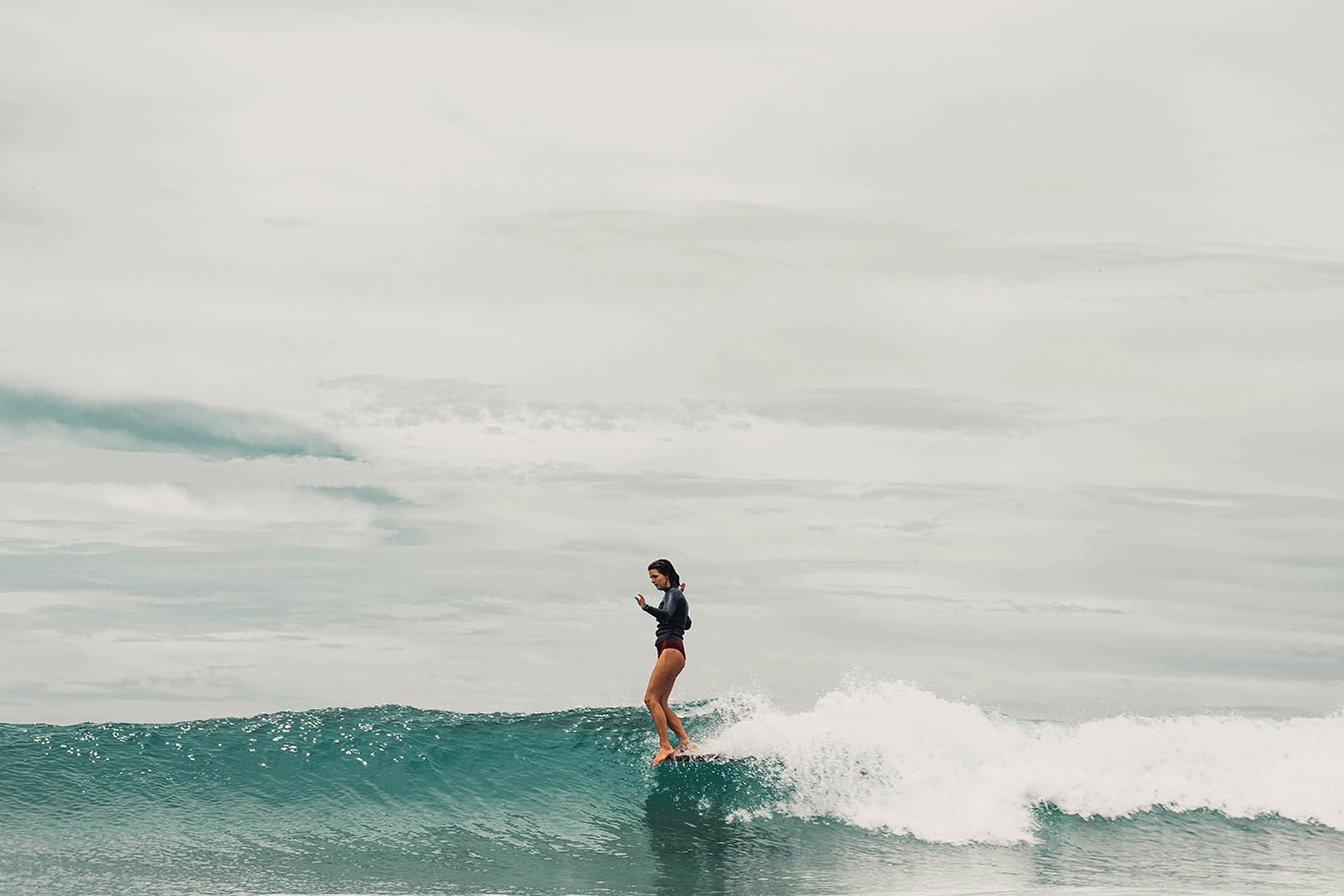
WHEN LUCY SMALL LEFT THE WATER AFTER PERFORMING WELL IN THE FINALS OF LAST YEAR’S CURLY MALJAM, SHE DIDN’T KNOW IF THE JUDGES HAD DEEMED HER THE WINNER. The MalJam is promoted as Australian long-boarding’s premier Sydney event. According to its Facebook site it ‘attracts the cream of the nation’s riders, past and present World Champions, all going head-to-head with the best of the locals’. While waiting for the presentation to begin, Lucy took a quick glance at the novelty-sized winners’ cheques and was immediately struck by the discrepancy between the amount awarded to the women’s winner ($1500) and the men’s ($4000). She also double-checked that the entry fees had been the same. Like many surfers, Lucy had closely followed the media surrounding the WSL’s decision in late 2019 to introduce pay equity for women and men in all its events. The Maljam was not a WSL contest, but Lucy had hoped the WSL initiative would inspire contest organisers in all surfing events to introduce prize money parity. Prior to the presentation Lucy raised the prize money discrepancy with her fellow finalists. Together, they floated the idea of taking up the issue after the ceremony. However, when Lucy was announced as the winner she felt compelled to seize the moment. Fighting off nerves, she accepted the micro- phone on the insistence of the unsuspecting MC, and then eloquently made her point. “… Thankyou so much to the sponsors for putting the money they’ve put into the event, but I would say that it’s a bittersweet victory knowing that our surfing is worth less than half of the men’s prize money… It cost us the same amount of money to fly here. Accom- modation costs the same, and our surfing’s worth half as much. So, maybe you can think about that for next time.” Someone filmed the speech and placed it on social media soon after. As Lucy talks, the crowd can be heard reacting in slight shock and then applauding. While emails and quiet diplomacy may have fallen on deaf ears, podiums have a long history as being very effective places to convey a political message. By utilising the natural drama of the setting, there was a sense Lucy had done something quite bold and transformative. Sure enough the Instagram post soon went viral. Lucy already had a political dimension to her life, working as part of the federal campaign … Read more

SPEND TIME WITH KYUSS KING AND YOU QUICKLY REALISE THE 21-YEAR-OLD IS MAKING BOLD STEPS IN ALL KINDS OF DIRECTIONS. THE BYRON BAY NATURAL-FOOTER HAS BEEN A MAJOR PRESENCE IN SURFING EVER SINCE HE HIT THE SCENE AS A PRODIGIOUS GROM WHIPPING THROUGH TURNS TRAILED BY A SHOCK OF BLONDE HAIR. Tilted carve with both hands dropped to maximise rail leverage and steezy aesthetics. Photo: Swilly. Blessed with Nordic good looks (his mother is Danish) he’s been raised on a diet of perfect right-hand points and heavy metal since he could crawl. Kyuss was named after one of the coolest stoner rock bands in the world. Their baking hot-riffs, languid, serpentine grooves, and go-slow nonchalance seemed to encapsulate the vastness of the California desert that spawned them. As a counterpoint, Kyuss was born and raised in Byron Bay, a town famous for its eclectic mix of creative influences. Now the Australian, who spends plenty of time in the States, is borrowing from both worlds, formulating a path that transcends all stereotypes. In the water, Kyuss can unleash a full-fury rail game or make a steezy statement above the lip. Toss him a singlet and he summons a ruthless streak and calls on a decade of contest experience. The 90s may be back in vogue but Kyuss has always been dialled into an era when surfers had a little more daring and dash. He takes his cues from virtuosos like Archy, Christian Fletcher, and Pottz. They weren’t exclusively freesurfers or comp surfers they were a 24/7 act. When it comes to Kyuss’ quest to make the CT there’s little doubt he has Pottz in his corner. “You know, the guys I watch now, the Morgan Cibilics and Conner Coffins – two guys that are in the top five going into that last event. I think Kyuss’ surfing is right up there with those guys without a doubt.You know, so if they’ve got the ability to make it there, so does he…” Pottz has kept an eye on Kyuss since he was as a grom and his connection with the family runs deep. In the 90s, Pottz lived in Avalon on the Northern Beaches with Kyuss’ dad Justin and the pair have remained close friends ever since. Pottz sees a unique set of triats in Kyuss’ surfing/ “You could tell straight away there was a maturity in the way he approached a … Read more

In the mid-60s circumstances conspired to put Steve Cooney on a fast-track to surfing stardom. By the time Steve was a plucky grommet paddling out at Collaroy point his older brother, Butch, was already a celebrated surfer and budding shaper. Meanwhile, NatYoung lived up the road and christened Steve and Butch with their nicknames (see extract). As part of the heady Northern Beaches scene, young Steve traded waves and board info with surfing luminaries like Nat, Bob McTavish, and Wayne Lynch. He soaked it all up and by 1971, he was NSW Junior Champion, eclipsing Mark Richards and Simon Anderson in the finals at Narrabeen. However, in a move, which perhaps foreshadowed the birth of the ‘freesurfer’, Steve was already involved in Albe Falzon’s production of ‘Morning of the Earth’. Bali’s surfing potential was still a whisper amongst the few surfers who’d been there but after a tip-off from Russell Hughes, Albe decided he’d fly into the newly built Denpasar airport and chase down more footage for his film. In September of 1971 he invited 15-year-old Steve to join him, alongside Alby’s partner Tanya Binning, Rusty Miller, Paul Hutchinson and his brother Geoff, and Peter Debono (co-owner of Hutchinson Surfboards). When Albe stumbled across a promis- ing set-up on the Bukit peninsular, Steve, in the absence of proof otherwise, famously became the first surfer to ride Uluwatu. By February the following year ‘Morning of the Earth’ had begun its tour around Australia and Steve was the ethereal, teenage wunderkind, gliding across a shimmering Uluwatu wall on the big screen, before enraptured audiences. It was Steve’s rides, alongside Rusty Miller, that inspired a generation of surfers to abandon all other ambitions and set their sights on Bali. While he might have made a bigger claim on his place in surfing history, Steve, by his own admis- sion, never dealt that well with the all the attention. Now, 50 years later he has released a memoir, ‘Unearthed’, which explores the full story behind those seminal sessions in ‘Morning of the Earth’. However, this is much more than a tale of surf adventure and discovery as it weaves delicately through family tragedy, surfing revelations, unexpected twists and famous cameos. In the grittiest sections, Steve reflects on his family’s complex dynamics with welcome honesty; detailing growing up as the youngest of six in the 60s with a widowed mother and eldest brother who had … Read more

If someone asked you to articulate what it means to dedicate your life to surfing, you might point to Rusty Miller as the ultimate case study. Rusty started surfing in 1953 and cut his teeth in the breaks around Encinitas, in Southern California. While he idolised Oceanside’s power-surfing pioneer, Phil Edwards, Rusty also made his presence felt in L.A.’s Malibu beach scene, where Edward’s rival, Miki Dora, was a cult figure. Although Rusty and Dora differed in their methodology they became tight as they figured out how to make a buck from surfing in1960s California. While Dora’s nefarious schemes became a thing of legend, Rusty relied on a mix of wave-riding competence, entrepreneurial nous, education, and persistence. Rusty worked hard at his surfing and claimed the USA Title in 1965. Along the way he earned a B.A in history at college and fashioned a reputation as the thinking man’s surfer. Regular trips to the North Shore solidified his reputation as a notable big-wave rider; combined with his competitive success this meant he could lend his name to a product and make it marketable. Hamm’s beer famously used a shot of Rusty roaring down the face at Sunset in a billboard campaign. Meanwhile, Rusty, Garth Murphy and Mike Doyle had success with the surfboard adhesive Waxmate. In 1968, just before the trio sold the wax company, (it later became Sticky Bumps) Rusty bailed for Kauai where he became good friends with Harold Taylor, the brother of actress Elizabeth Taylor. Taylor had ceded much of the estate he owned to a collective of hippies who established a commune in a spectacular, tropical rainforest setting. Rusty spent three years living in a fisherman’s hut, hanging out with Howard Taylor, and riding the glorious waves of Hanalei Bay. Eventually, he visited his friend and former business partner, Garth Murphy, on the north coast of Australia. Rusty was instantly drawn to Australia’s long, right points, vibrant surf culture and the anti-Vietnam stance of Prime Minister, Gough Whitlam. In 1971, Albe Falzon and David Elphick decided they wanted to take a bet on Bali as the new surfing frontier that would deliver their film project a knock-out punch. Albe had already recruited Stephen Cooney, a gifted young surfer from Collaroy who had been involved in the early phases of filming, which centred on the NSW north coast. Steve, who had left school to go on the … Read more