Great to talk you Otis. How’re you finding juggling parenting, freesurfing and now a flourishing art career?
They all seem to go hand in hand. Like being a dad is a 24/7 job. But I guess with art I can go have a surf and rejuvenate and then come back to the painting. If I’ve been surfing, I’ll take a break from that and spend more time painting. So for me it works out well. Most of my days are filled with art now. It’s going good but it can be tiring at times. What I do is pretty tedious, it’s very time-consuming. It’s not something I can spend an hour or two on and be done for the day. I’ve got to spend five or six hours at it, just chipping away.
Were you an arty kid? Always colouring and drawing?
Nah, not at all. For the first few years of my life we were living in the bush. I was really into football, soccer and rugby and I was surfing in between. No one in my immediate family were artists so I wasn’t surrounded by it. There wasn’t much of an artistic outlet as far as applying paint to canvas. That only started four or five years ago. I think, looking back, I was using my brain in a different way to other kids but not actually creating art.
Can you tell us a bit about how your approach and subject matter has evolved over the last few years?
It started out just pen on paper, illustrative stuff and then branched out from there. I was living in Sydney at the time. I started experimenting with patterns. As I began to understand how we use our traditional symbols in story- telling that’s when it all started to fall into place for me and I began to understand the practice and how important it was to paint culture properly and to be able to share those stories with people. Ever since I started painting, I wanted to paint Aboriginal art works, but I never knew how to approach it. I always felt it was there. I feel Ozzie Wright, even though he’s non-Indigenous and our approaches are on totally different
ends of the spectrum, he’s full of such knowledge and being able to spend
so much time with him has helped me grow and to understand where I wanted to take my art and how to execute it. It’s funny how things work out like that – because we are two very different artists.
Are there restrictions about what cultural knowledge you can share or how you present it?
Yeah, there’s definitely restrictions.
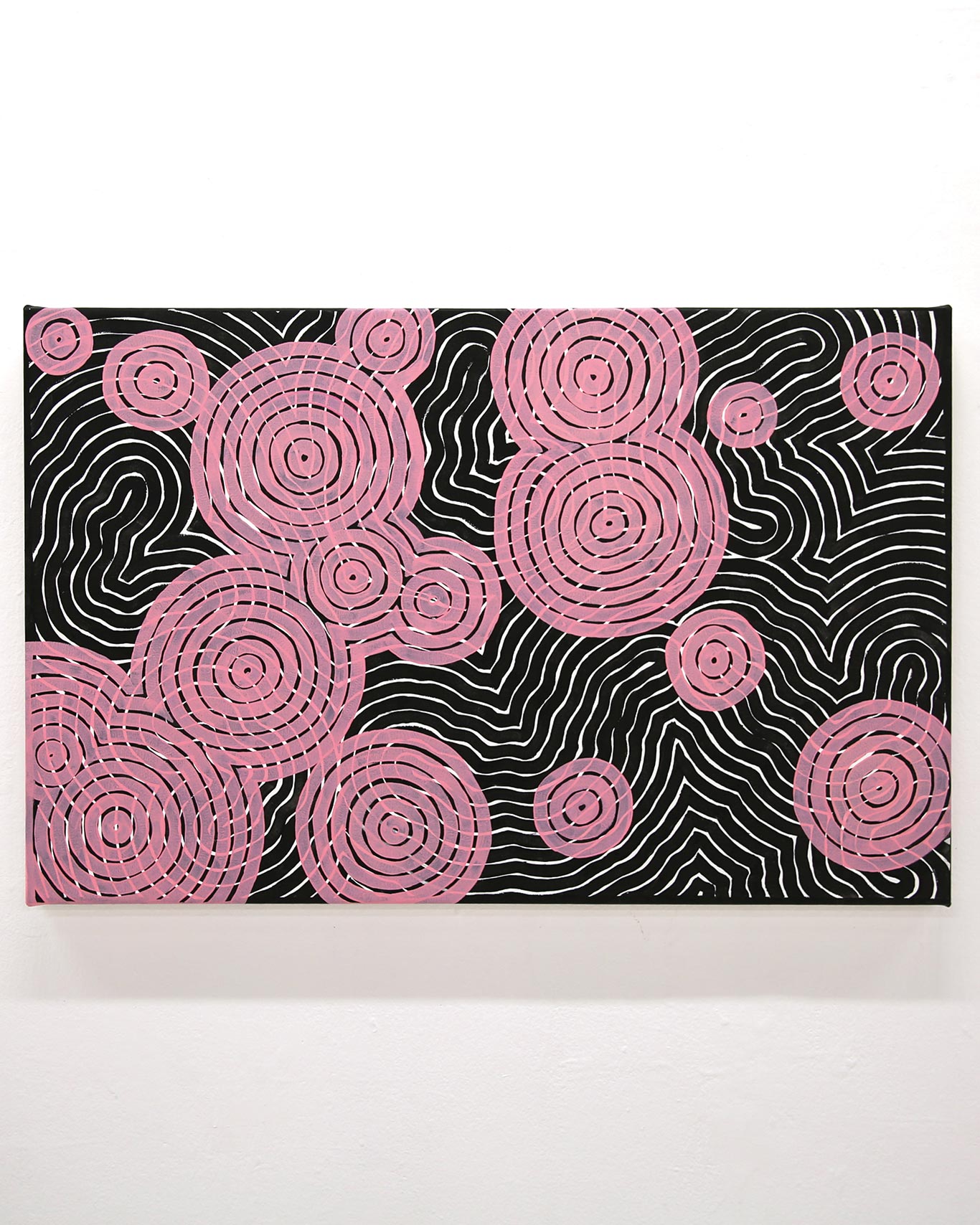
Like there are a lot of Dreaming stories that we can’t tell or can only tell part of the story. So, if I’ve got an idea about a particular story, I’ll go to an Elder and have a yarn. Ask what parts of the story I can share and is it ok to paint it a certain way and what symbols I can use. I spoke to Elders back home about putting stories into paintings and whether I was doing it right. What I found easiest for me was to paint in a contemporary form which is more of a softer broken-down way of telling a traditional story. I find it really hard to express myself through words – I’ve got to sit down and think about what I want to say and how I feel. Whereas with a painting it’s just there and I know what it feels like and I know how it fits. Straight paint to canvas.
Surfers experience an intensely focused mind state when they’re riding a wave. Do you experience something similar when you’re painting?
Yeah, so whenever I’m painting and I know what I’m painting and the canvas
is in front of me, there’s a vision. Like in surfing there’s always a vision of what
you want to do on a wave. Sometimes the wave doesn’t let you execute your vision in a way that you wanted to and it’s the same with a canvas; even though a canvas doesn’t change, your emotions will.
So, what you end up with is not necessarily what you originally planned?
Yeah, yep.
The age-old question: Is surfing a competitive sport or a performance art?
It’s hard for me to pick one of the two. I still do a few comps. I do a lot of the Indigenous comps and I love doing the local boardriders with everyone. I think surfing is so free-spirited it’s hard to see it in the light of professional competition where people are judged for what they do on a wave. It’s a pretty weird concept but it can actually be quite exciting at the same time to watch people in a heat. I quite enjoy [comp surfing] but I think it’s more of a free-spirited expression.
The ocean features prominently in a lot of your paintings. Can you explain its significance to the Gumbaynggir mob?
Gaagal (the ocean) is one of our clan totems. We’re a coastal mob but our Country also goes way back west to the Nymboida River. It’s such a big river it feels like Gumbaynggir is surrounded by water. It’s hard to explain the significance culturally but if I went way out in the bush off-Country I get really jaded and feel the pull to come back here. I’m still trying to gather all those feelings and thoughts about what the ocean means to me and my people. We’re very very connected to it. Like as soon as I land [at the Coffs airport] I can physically feel energy come up through my feet to my head and hands. It’s a nice feeling.
Any particular surf spot you feel a special connection to?
My favourite beach in the whole world is McCauleys. There’s a goanna Dreaming story about the headland there at McCauleys. I don’t know why but I’ve always loved goannas and felt a connection with that place. I love surfing there – there’s like a right rip bowl and a left sort of point break off the headland.

Otis getting creative in studio one. Photo : Sean Salilila 
If you think Otis’ passion for art has slowed him down in the water, you better think again. Photos : Kane Skennar 
Laying down some work in studio two. Photo: Kane Skennar 
If you think Otis’ passion for art has slowed him down in the water, you better think again. Photos : Kane Skennar 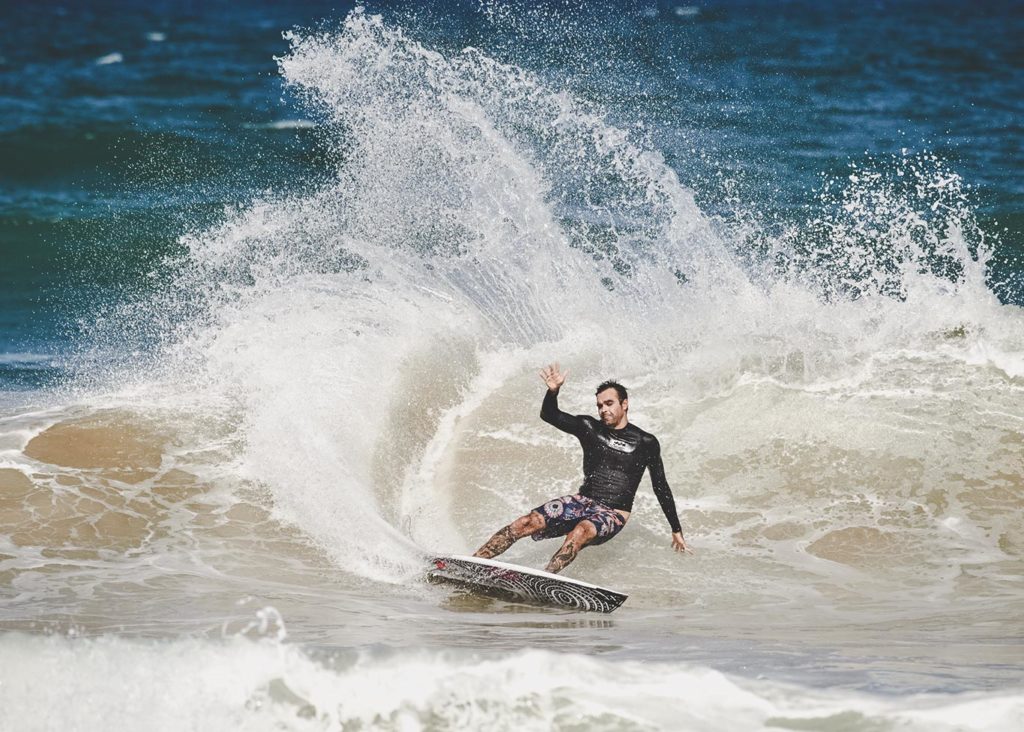
If you think Otis’ passion for art has slowed him down in the water, you better think again. Photos : Kane Skennar 
Every brushstroke matters. when each piece you create tells an important story. Photo : Sean Salilila 
Chris and Otis admiring three weeks worth of work in Hemsworth’s new home. 
To see more of Otis’ work, or even purchase for yourself, head to China Heights Gallery’s site – chinaheights.com
Do all your traditional paintings relate to Country and culture or are some purely aesthetic?
Every painting I do has a relationship with a cultural story. Sometimes it might be something small in the corner of a painting. I’d like to branch out some more and do Indigenous inspired contemporary art but without that cultural label if that makes sense. Take little snippets of what I do and apply it in a more broken-down contemporary form.
The enormous wall mural you did for Chris Hemsworth has been getting a lot of accolades and attention. Can you tell us a bit about how that came about?
So one of my good friends is the foreman working on Chris’s house and Chris
went around to his place and saw one of my artworks hanging up. Chris was initially going to commission me to do an artwork to hang but then he ended up having this big wall in the downstairs of his house that he wanted something done to. So, he approached me and that’s how it came about.
How long did it take?
It was a big one. It took three weeks or about 140 hours of painting. It was a lot of work. Just me and a paint brush.
You get to hang with Thor much?
Yeah, I spent heaps of time hanging with him. I actually went surfing with him one morning. He was like you wanna go for an early? He said, “I’ve got a mate up at Potts Point he reckons the surfs pretty good.” So I was like cool – lets go up there then. We got up there and it was Kelly Slater. So, I ended up surfing with Chris Hemsworth and Slater. Pretty random.
You’ve been very honest about your battles with depression. Does art help pull you out of a dark head space?
Yeah, for sure. I feel like for me it’s such a good distraction. I sort of let all that [depression] go unknowingly. I feel like my brain works in different ways to other people. If I don’t paint, surf or go to the gym or go fishing or go out to the bush and do cultural stuff I sort of fall back into that state of depression pretty quickly. I feel like a lot of people need to exercise the mind in creative ways or in ways that are not conventional if that makes any sense. I think it helps a lot.
There’s been a huge response to the Adam Goodes TV special, The Final Quarter, which aired recently. What was your reaction to it?
I think it was good. I mean, even before the documentary came out I was already aware of what was happening and what he’d been through, so it was nothing new to me, but to see it brought to light on TV like that was a great step forward to give people an insight into what Aboriginal people have to deal with virtually every day. And it’s the kind of shit that I’ve had to deal with and a lot of Indigenous athletes and Indigenous people who are in the media a little bit. It’s quite common what Adam went through – it’s the same thing we all go through. So it was quite uplifting, and I think a step forward for everyone to understand each other a little better.
You’ve endured racism throughout your life. Do you think – despite what you’ve been through – that people are becoming more educated about how hurtful it can be?
I think so yeah. Maybe not politically but on the ground level I think it is [getting better]. A lot of children have access to a lot of different articles and people of different ethnicities, and I think it’s definitely changing. You’ve got to remember the people in government now were children in 1967 when Aboriginal people were first classed as citizens. Before that Aboriginal people were classed as flora and fauna. So that’s what they grew up with and their mindset is pretty far behind. They’re not keeping up with the times. They’ll die out and things will change.
What’s next? You’ve got a show coming up?
It’s on September six in Surry Hills, Sydney at China Heights Gallery. It’s basically an extension of the Chris Hemsworth mural. Because that artwork was received so well, I thought paint that as a body of work for the solo show. The show will be called Darrundang Gaagal which is thanking the ocean. I’ve done 16 small paintings and then I’ll do eight bigger ones, two huge ones and one massive hero piece. So it’s going to be a lot of work. I’m about halfway through it. I’ve got to move houses and I’ve got a teething baby so it’s pretty full on now. But I’ll get there.