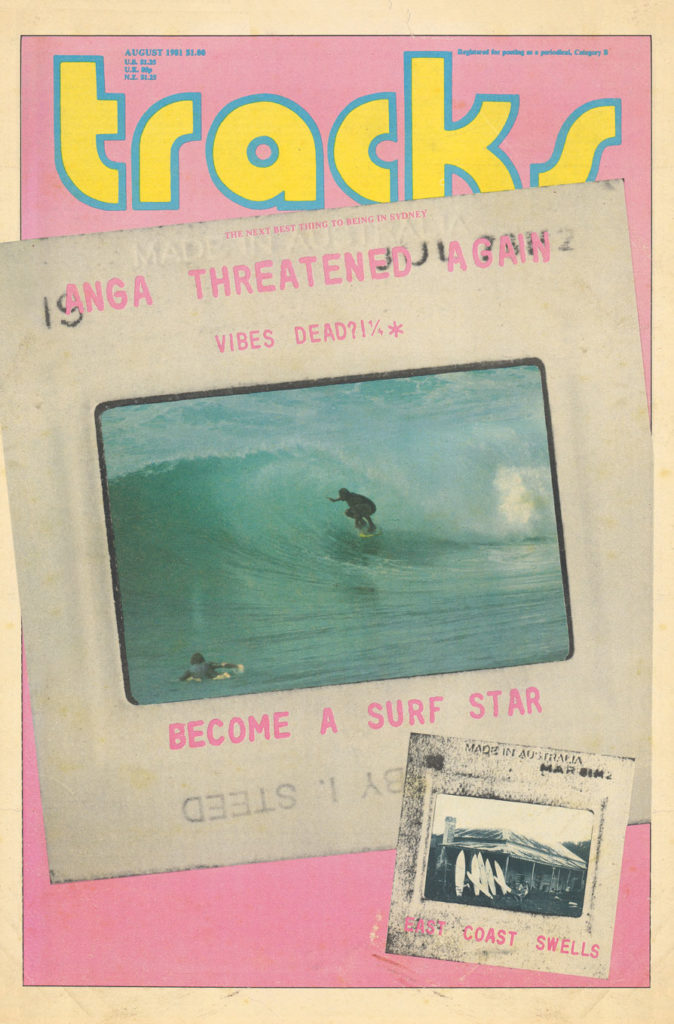
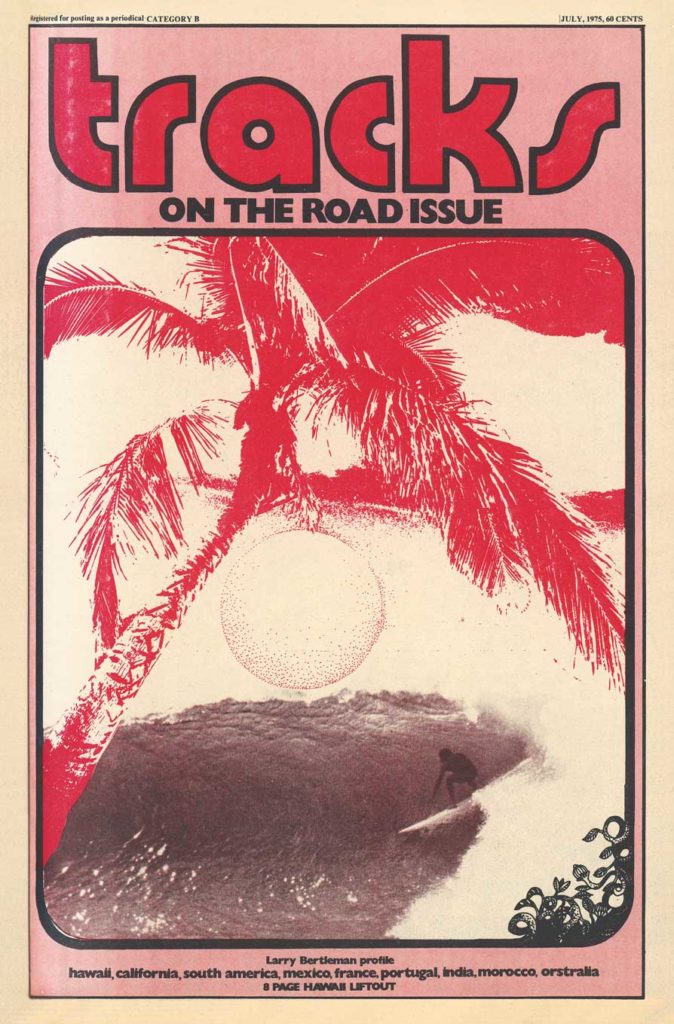
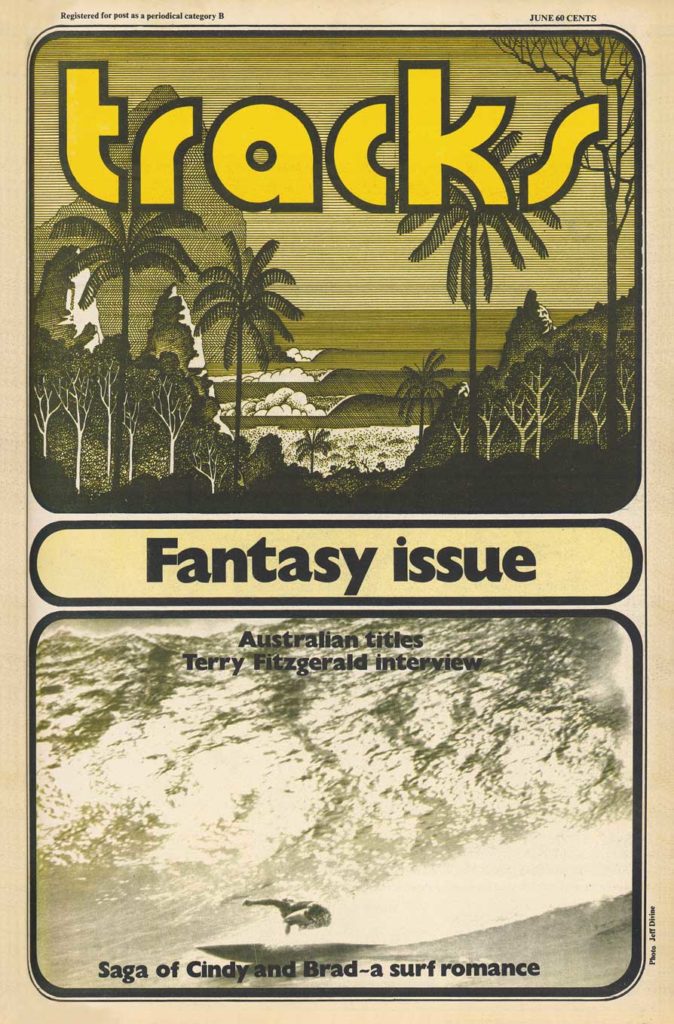
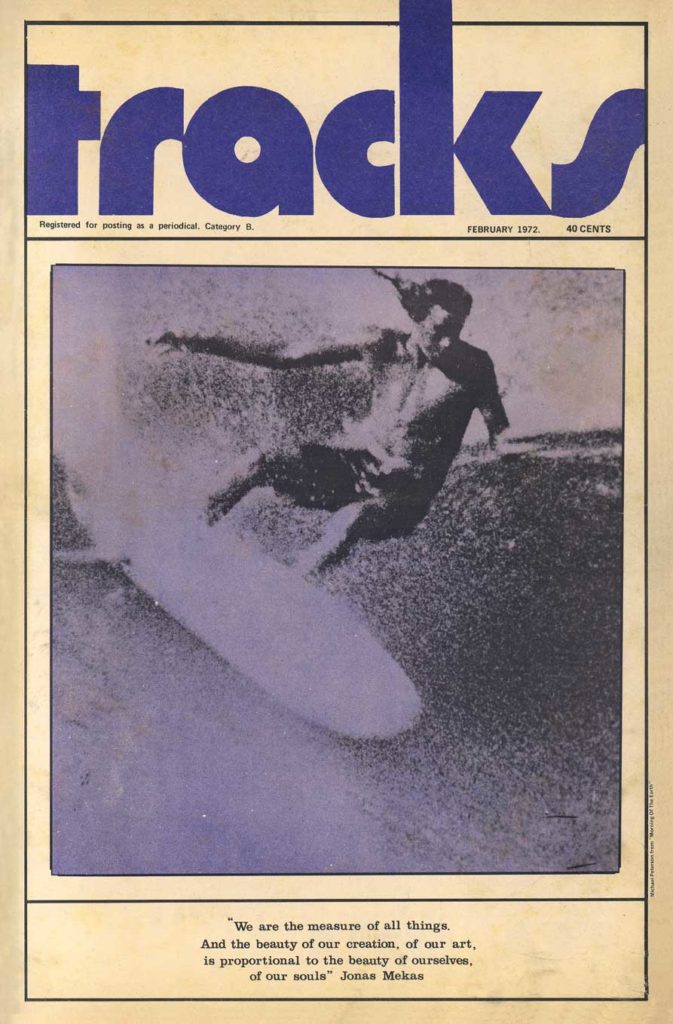
Andrew Stark is widely being touted as one of the leading contenders for the role of WSL CEO, which was recently made vacant with the departure of Erik Logan. ‘Starky’ is a former CEO of Surfing Australia and is currently the WSL’s General Manager for Australia Asia & Oceania. Starky also loves to take on Sunset and Waimea and boasts a quiver of Brewers built specifically for the task. Tracks once dubbed him ‘The Kelvinator’ in honour of his robust frame and forthright approach to big waves. More recently Phil Jarratt wrote a compelling feature for Tracks on Starky’s journey as a surfer and industry heavyweight. Read below to find out a little more about the surfer tipped to become WSL’s new CEO.
***
Man In The Middle
The WSL’s boss in Australasia sits in a hot seat somewhere between surfing’s core and corporate guises, and, apart from the time he steals each year to bob up and down in a wild and maxed-out lineup at his beloved Sunset, he’s never been more comfortable. Just after sunset on a recent spring evening I walked into the Coolum Surf Club, looking for the first ‘Surf Ranch Sunshine Coast Community Consultation Session’, expecting to find a large meeting room full of local politicians, greenies, development boosters and maybe a few surfers. Instead, I was directed to a space about as big as two broom closets, hidden at the far end of the vast club, where a big man with the demeanour of a front rower was holding court in the midst of a tight scrum of the movers and shakers of Sunny Coast surfing. Dressed in his usual work clobber of neat collared shirt and pressed chinos, Andrew Stark, former manager of Surfing Queensland, then CEO of Surfing Australia, and now general manager of the World Surf League and WSL Wave Company for Australia, Asia and Oceania, was working the room, pressing the flesh, and, in between bites of the WSL’s free pizza, joking about the usual spring surf drought and how he was going to fix that, haw haw, you just wait and see.

Three kilometres inland of this tiny room, and just a 20-minute drive from the fabled points of Noosa, is the swampy 500-hectare site on which WSL and its partners plan to build the first Kelly Slater Wave Ranch outside of the prototype in California, so Andrew Stark has brought us almost to ground zero to deliver the good news. Right here in the birthplace of Bjelke Jo’s white-shoe brigade, you could be forgiven for mistaking Starky – as every man and his dog knows him – as just another bog- standard time-share hustler, right down to the hail-fellow-well-met and the ever- present Irish smile, except for the quiet confidence he exudes as he moves from group to group, remembering names, talking surf. And when he finally calls the room to order in his understated way, so he can begin his presentation, and you realise that everyone is already on his side, that’s when you know you are in the presence of a master of the game. And a master is what Andrew Stark will need to be, if he’s to pull together the many disparate threads of what several of his friends regard as the biggest gamble of his 20-year career as Australian surfing’s most daring administrator and entrepreneur. But Starky is no stranger to risk-taking. It’s what his whole surfing persona is based upon. Says his friend Ben Crowe, the Melbourne life coach who numbers among his clients Ash Barty and Steph Gilmore: “Two of the needs we have in life are certainty and uncertainty, and when I met Starky I’d never seen anyone with a greater need for uncertainty, or chaos, which in his case was about putting it all on the line in big waves.

He needed to find that balance between courage and consideration, and I believe he has.” Says friend and business mentor Norm Innis, former Chair of Surfing Australia: “Never share a room or a house with Starky. The bugger is up in the dark every morning, frothing like a grommet to go surfing, regardless of the swell, wind or how much we had to drink the night before, and he makes you go too. For three or four hours!” Says editor of this August publication (and fellow North Shore tragic) Luke Kennedy: “I’d like to steal his Sunset quiver and borrow his confidence.” So what are we dealing with here? A hard- arse tycoon in the making, or a serious salt in a silly suit? Well, in truth a bit of both. Andrew Stark was born in Brisbane in 1976, the second child and first son of rising advertising executive Dave Stark and Helen Manning Stark, whose father, Clarence Manning, was a revered third- generation newspaperman. So Starky was surrounded by spin right from the get-go. But Dave Stark was also a surfer.
When Dave was a youngster, the Stark family spent weekends and holidays at the family beach house overlooking Moffat Beach in Caloundra at the southern end of the Sunshine Coast. From an early age he and his older brother John ventured out into the lazy right- hand point break on borrowed toothpicks at first, then primitive longboards. As a teenager at the dawn of the 1960s, Dave became a member of Ma and Pa Bendall’s original Moffateers, the funky little club that produced more than its fair share of champion surfers, largely due to the indefatigable enthusiasm of Pa, a former Canadian fighter pilot who wore an eye patch, and, while not pretty to watch, surfed with a noisy intensity that was inspirational. In no time at all, Dave Stark had moved through the ranks from ‘six-plus’ Moffateer to ’12-plus’, meaning that Pa had judged him proficient enough to surf the point as big as it got, and he did at every opportunity for the rest of his life. Some of Andrew Stark’s earliest memories are of his dad paddling him into frothing swells far too big for Moffats to handle. “He took me out there in big surf at a ridiculous age. I’ll never forget being hit in the face by this guy’s board on a big day – I still have the scar on my eyebrow – and he abused me, like what are you doing out here? You’re just a kid! And I said I was out there with my dad, and he goes who’s your dad? I said it was Dave Stark. And he goes, oh, of course he is.” Back in 1967, the year that fellow Moffats surf rat Bob McTavish lopped a few feet off the standard length of a surfboard, Dave Stark’s number had come up in the lottery called National Service. By the end of the year he was in the frontline in Vietnam. When his tour of duty was finally over, his beach mates at Caloundra noticed that he was quieter and more reserved than before, but it only took one decent swell to bring the manic gleam back to Starky’s eye as he paddled out at Moffats. By the time young Andrew was old enough to be pushed into a wave, Dye and Stark Advertising Associates was one of Brisbane’s top four advertising agencies and Dave was busy day and night. But Friday nights were sacrosanct: wife Helen and Andrew’s older sister Cathy would head off for a horsey weekend at the pony club, while Dave and Andrew would zoom up the highway to Moffats to surf all weekend. Starky recalls: “Dad was my best friend. He was my surfing buddy, manager of my junior rugby team. He had this fantastic energy, everything with him was always fun.” When Dave Stark returned from Vietnam in 1968 there was no parade, only protest marches. He was told to go home and not talk about his war. But almost 20 years later, the political mood had changed. People had come to realise that soldiers, particularly conscripts, were mere pawns in an unjust war. Prime Minister Bob Hawke announced a belated welcome home march through the streets of Sydney, honouring Vietnam veterans for the service they had once been blamed for. Dave and his Nasho mates booked their flights.
The Welcome Home parade of October 3, 1987 was a huge success, with more than 20,000 veterans marching and 100,000 onlookers cheering them. Five hundred Australian flags held aloft by the veterans honoured the 500 Australian soldiers who had died in Vietnam. Dave Stark came home after a few days, elated by the experience. But he was never the same again. After more than a year of growing depression and anxiety, David Malcolm Stark took his own life on January 10, 1989, one of hundreds of undiagnosed victims of post-traumatic stress disorder in the wake of the Welcome Home, the unknown dark legacy of a stupid war. Dave was just 43. Andrew was 12, a couple of weeks away from starting high school at Brisbane Boys College.

We are sitting in Starky’s office at WSL HQ in Coolangatta, looking out over a much-needed rainstorm belting into Greenmount. The big guy pauses, pretending to scan the point for signs of a new swell, but lost in a different time zone. “I was too young to fully understand it, but it was pretty weird. He went to live with his brother for a while, and he was in and out of hospital. The last time I saw him was at Moffat Beach, under a tree near the boat ramp, looking out over the surf.” The moment passes, we slide into happier times. Dave Stark’s best mate, lan Dickson, another Moffats surfer, becomes a surfing mentor and a surrogate dad. When not playing rugby, Andrew surfs bigger and crazier waves, always guided by his father’s energy. Starky has gone, long live not-so-little Starky! Starky was a good student, despite his insatiable lust for surf, and he was accepted into Queensland University of Technology’s Business Management Faculty, where he majored in marketing, thinking about following his father into an advertising career. But lectures came a distant second to surfing, particularly after he’d moved into a share-house on the Gold Coast. Ironically, however, it was surfing that gave him his first taste of business and leadership, when he was elected president of the struggling QUT Boardriders Club. He recalls: “It was a tiny little club, but my mates and I were studying business, so we thought we’d use it as a model, and over three years we increased membership from 20 to 250, got some sponsorship and got stuff happening.” After Uni, the graduate went to work for Terry Morris, the Gold Coast-based marketing wizard with his fingers in a hundred high-profile pies, including Queensland wine, boutique pubs and mega-markets, but Starky saw it not as a long-term career but a short-term cash injection – he was going to see the world, and surf it! Starky had already done his time in Indo – some of it on early Mentawais explorations – but this was a serious mission. Stark recalls: “In June 1999 I finished up with Terry, flew to Perth, met a mate with a fully-kitted Troop Carrier and we drove straight to the Bluff, camped there and surfed our brains out for eight weeks. Then we came back down to Margaret River, where I really developed a taste for big, powerful waves. Then we drove back around Australia to the Gold Coast. A month later I left for New Zealand, Tahiti, Easter Island, Chile, Peru, Argentina, Brazil and Mexico. “In Chile I surfed Punta de Lobos at solid 10-feet with no one else out, and I nearly died. To get to the wave you have to time it just right – paddle across this surging channel to a big rock, then you climb up the rock and jump into the break on the other side. Fucking gnarly, especially if you’re on your own and you’ve never surfed there. Some guy had just told me where to jump off, so I completely mistime it, a set washes through and washes me into a whirlpool with rocks sticking up everywhere, and I’m getting cut up and pushed under by waves, but I manage to get out into the lineup way out at sea, and I’m sitting there wondering what I’m doing when a huge seal comes out of the water and starts barking and nudging me. Just crazy shit.”
After a long stay in Mexico, Starky flew up to Banff in Canada to do a season snowboarding. It didn’t end well. Typically pushing the edge of the envelope with some Canadian instructors, Starky jumped off a cliff, landed on ice and snapped his wrist really badly. He says: “I was in hospital for a week while they operated on it, then I came back to Australia and the doctors here said the wrist was completely fucked and they had to start again. I had to have a bone graft from my hip and have complete reconstructive surgery. So, I’ve gone from the euphoria of travelling around surfing all these great waves to finding myself back in Australia, black and blue all over, lying in a hospital bed on a drip.” Stark had five operations in six months. Twenty years later he flexes his damaged wrist while he talks: “I told the surgeon I couldn’t have a fused wrist or I’d never be able to get to my feet on a surfboard, so they did the best they could. But if you look at any of my surfboards now, you’ll see they’ve all got wax over the rails, because that’s how I get up, my wrist won’t turn all the way. That’s why I’m a little bit slow to get to my feet sometimes, because I can’t bounce up off my wrists. You learn to live with it.”
It’s a new century, and sitting in his unit at Palm Beach staring at the surf during his rehab period, pissed off about his inability to surf and uncertain about his future, Starky is so bored he opens up the Gold Coast Bulletin. “And there’s this little ad under the heading ‘Surfing Administration’. I thought that sounded interesting, so I phoned the number and spoke to a bloke called Bushy Mitchell. That’s how I started with Surfing Queensland, a job I had for nine years.” Historical note: Although the governing bodies of surfing in Australia had operated (more or less) under a federated model since the inception of an organisational structure in 1964, it was a sketchy alliance of competing interests right into the 2000s, despite two decades of steady national management by Surfing Australia CEO, Alan Atkins, and President Rod Brooks. As the axis of surfing moved from south to north, Surfing Australia relocated from Torquay to the Gold Coast, moving into a small suite of offices next to Surfing Queensland in the Old Burleigh Arcade. While Robert “Bushy” Mitchell moved into the federal sphere as Surfing Australia Chair, Andrew Stark became Surfing Queensland’s Operations Manager under General Manager Matt Wilson. It was a fiery introduction to the politics of surfing.

Starky proved to be a tough operator who got the job done, whatever it was. In his early days he found himself running a QS event at Cloud Nine in the Philippines. The Aussies did well, and in Manila on the way out, there was a small celebration that saw one well-known reveller finishing a drunken all-nighter in a downtown gun parlour, firing AK47s at moving targets. In his stupor, the party animal souvenired the live bullets handed out as earmuffs, then scooped up a bunch of spent shells and filled his pockets.
Starky got the tearful call from the airport in the early morning. Party dude – one of Australia’s highest profile surfers of the era – had sent the security alarms into spasms and had been carted off to a cell by a squad of heavily-armed uniforms. In post-9/11 times, trying to board a plane with live ammunition was worth more than a lecture. Starky worked the phone and pieced together a strategy. Going to court was going to be a long and costly process liable to end in more tears, but party boy’s freedom could be bought for cash. Starky got his maximum $1K out of the ATM, and then remembered that the Aussie boys had been paid prize money in cash. He quickly made the rounds of bars and clubs, and amid protests, picked up what was left of the loot and took a taxi to the airport. Party boy was on the next flight home, advised never to return. Starky graduated to CEO after a few years at SQ, doubled the staff and increased the turnover tenfold, largely thanks to a lucrative deal to operate the Quiksilver Pro Gold Coast.
He had his share of spats with Surfing Australia and the other states, but by anyone’s key performance indicators, he was a success in the job. Strangely, asked to recall the high points, Starky nominates the boozy 30th anniversary of the 1977 inaugural Stubbies Pro, the man-on-man event that changed the face of pro-surfing. I remember a bunch of overweight former pros trying to recreate the golden moments of the original event in onshore dribble, then later at the lunch introducing the guest speaker, a middle- aged person in eyeliner, a string of pearls and a pair of daring matador pants, who turned out to be Peter Drouyn in the first stages of his Westerly adventure. Much later, I also recall helping push a near-legless Rory Russell up the hill to his bed in Goodwin Towers. (Thankfully Rory survived a heart attack on the plane-ride home.) One thing emerged from all of this whacky strangeness: Starky knew how to make a splash. When Andrew Stark broke his wrist in Canada in 2000, he missed out on ticking the most important box of his world surf tour – Hawaii. He recalls: “It had always been my goal to get there, the culture, the big waves, the whole package, and now I’d surfed quite a few big wave locations, but I’d never really been scared. It always reached the point where I wanted more.” He finally got his shot in December 2004, and it was a baptism of fire. Burleigh legend the late Denis Callinan hooked him up with a place to stay at Sunset and organised a quiver through shaper Dennis Pang. On arrival he drove to the North Shore, picked up an 8′-6″ and a big gun 10′-0 at Pang’s and went straight to Sunset, where there was a building swell. True to the traits that would make him a Sunset notable, Starky examined the lineup for all of a nano-second, grabbed the 10′-0 and paddled out. He says: “It was big and getting bigger – eight-10 feet Hawaiian – but I just felt like, I’ve found it! This is my place! That afternoon I surfed until it was almost dark. I thought I was the only guy in the water, but then a surfer who turned out to be Ken Bradshaw paddled up to me and said, you should go in. It’s getting bigger and it’s getting dark, you’re going to get cleaned up. But I didn’t take the advice, I stayed out there and I got mowed all the way to the beach, and all I could think was, this is my place, this is it!”

We’re sitting outside a coffee shop at a Sunshine Coast resort complex where Starky is soon to meet up with Don O’Rorke, and the two of them will do the old soft-shoe with a prospective partner in (or opponent of) the wave pool development. I ask a long, convoluted question which boils down to how deep, exactly, are Dirk Ziff’s pockets? The Starky of old may have blown a fuse, but this one just sighs deeply, grins and launches. “I’m not going to comment on the financial leadership of the WSL, other than to say that it has a bright future. I wouldn’t have taken the job unless I thought that this organisation was set up to succeed, and I think you’ll find that the business is set up now to really go to the next level. For 40 years it’s been about running the World Tour. Now we’re diversifying, becoming an enabling platform for the entire sport or lifestyle. Crowning World Champions is still our core business, but now we’ve entered the world of content, talking to a wider audience, building wave pools. We’ve gone from a fan-centric base to a consumer-centric base.” Starky would rather talk surfing, specifically Hawaii, where he’ll soon be heading. Having started the day with a killer pre-dawn session at Snapper, he’s going to spend the rest of it talking business around a conference table, so come on, Phil, give me a break!
Do you ever have doubts in big waves? “Oh yeah, particularly now being older with a wife (Belinda, for 11 years) and young kids (Lily, 8, Chloe, 4), and particularly because my dad left me when I was 12. I don’t want to do that to my kids. I’ve nearly drowned three times, and the last one I really thought it was curtains. It was early January this year, and I’d had a moon boot on for eight weeks and hadn’t surfed or trained before I got to Hawaii. There was this huge storm coming across Haleiwa from Kaena Point. I’d been watching Jamie Mitchell at Sunset since early but it wasn’t great so I thought I’d sit it out and let the morning sickness go away. It was proper 15-foot Sunset, borderline closing out across Kammies. I waited too long and as the storm got close, I thought I’d get out there for one or two, so I took my 10′-6” Brewer Waimea board and put a flotation vest on. I hadn’t even caught a wave before the storm hit. It went from oily glass to 40 knots of onshore and belting rain. I couldn’t see a thing, couldn’t see land, couldn’t see the waves, and I did not want to be there. And then I heard it. I could see white water and I thought, here we go, thank God I’ve got the vest on. Then I got hit and dragged underwater and it blew the zip on the vest and it filled so I couldn’t get up. I still had my board attached, but I reckon I took seven on the head and I was on the edge of panic. I was in all sorts of trouble, but I got in.

“My eight-year-old, Lily, had been watching from the deck of our house, and she said, ‘Dad, don’t you ever do that again. Your daddy left you when you were little, don’t you do the same thing.” “So I’m more selective now. But I’ve still got my list. I really want to surf Jaws, and Jamie Mitchell has promised to take me over, but I’ll surf it on a 15-foot day, nothing crazy. I’m not out to hurt myself now. I’ll surf Sunset as big as it gets, because I feel more comfortable out there at 12-15 foot than I do at any other wave in the world. I love its currents and moods. I’m a way better surfer out there than I am anywhere else. At Sunset if I paddle for a wave, people know I’m going to take it. If you pull back, you’ll never get another wave.”