
CURIOUS SPECIES: THE FIRST WARUNG IN NUSA LEMBONGAN
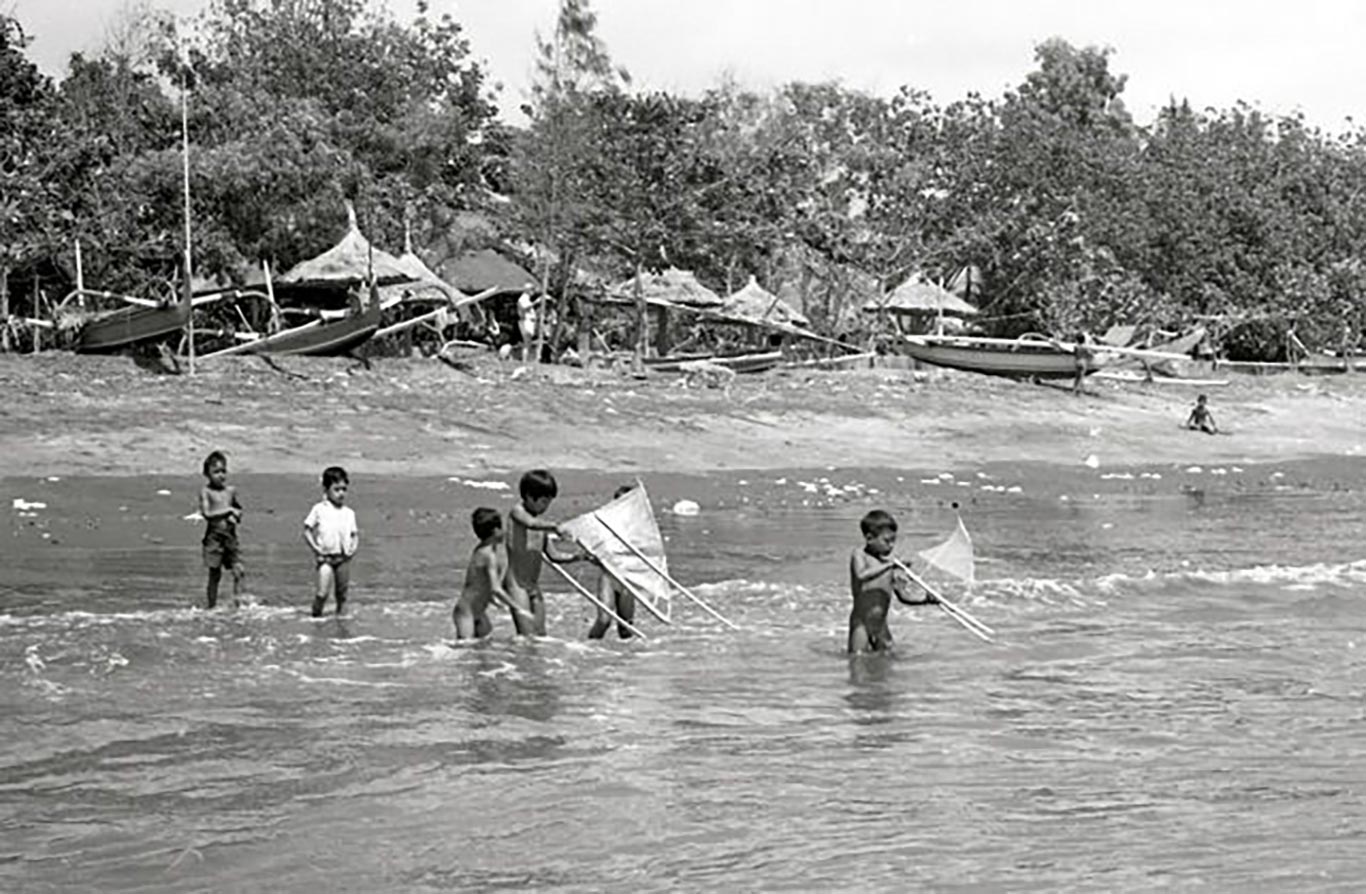
This is the story of the first warung in Nusa Lembongan. Or perhaps it wasn’t the first. But true to the nature of such stories, its charm renders us believers, and no one much cares to refute the claim. It is 1975 – or there abouts – and a nameless, sun-blanched young man hops a Jakung at Sanur, intent on crossing the deep, swirling eddies of the Badung Strait. A jakung is a traditional Indonesian outrigger canoe with a small outboard motor used by Balinese fishermen. He hopes it will carry him safely across the blue abyss, to Bali’s silhouetted sister island, Nusa Lembongan. She has been beckoning from across the sea, bathed in a low-lying mist, keeping her wave secrets to herself. Yet to be ornamented with hotels and villas, Jungut Batu is a fishing village, marked by squat huts with dirt floors. The floating water park and the charter boats are years away, and the bay is a silent, brilliant blue. Empty waves rise and fall with tide, unseen except by the wistful eyes of a fisherman, returning with his morning’s catch. Where the sand meets more solid ground there is a hut, made from bamboo with a thatched grass roof. At the open door, sheltered from the hot sun, a young man who will later call himself Jonny – for the ease of the ex-pats – watches as boats move into the bay. Inside the hut, a woman stands over a single flame, on which she fries ikan – fish, fragrant with kemiri, coriander and turmeric. A white man climbs out of a jakung and wades through knee-deep water onto the sand. The young man has seen some foreigners before, on this island, and heard of their coming and going in Bali in greater and greater numbers. This one carries something long and flat un- der his arm. He makes his way up the beach to the man’s home, the first obvious port of call. He is broad-shouldered, bronze-skinned and smiling. He knows a few words in Bahasa, which the man knows, as well as his own island dialect. They exchange words in fractured language, before the white man puts his bag down in the hut and removes the unusual object from its covering. At closer inspection, it appears to be a seafaring craft, made from similar watertight materials as they use in the fishermen’s boats. The … Read more
This is the story of the first warung in Nusa Lembongan. Or perhaps it wasn’t the first. But true to the nature of such stories, its charm renders us believers, and no one much cares to refute the claim.

It is 1975 – or there abouts – and a nameless, sun-blanched young man hops a Jakung at Sanur, intent on crossing the deep, swirling eddies of the Badung Strait. A jakung is a traditional Indonesian outrigger canoe with a small outboard motor used by Balinese fishermen. He hopes it will carry him safely across the blue abyss, to Bali’s silhouetted sister island, Nusa Lembongan. She has been beckoning from across the sea, bathed in a low-lying mist, keeping her wave secrets to herself. Yet to be ornamented with hotels and villas, Jungut Batu is a fishing village, marked by squat huts with dirt floors. The floating water park and the charter boats are years away, and the bay is a silent, brilliant blue. Empty waves rise and fall with tide, unseen except by the wistful eyes of a fisherman, returning with his morning’s catch.

Where the sand meets more solid ground there is a hut, made from bamboo with a thatched grass roof. At the open door, sheltered from the hot sun, a young man who will later call himself Jonny – for the ease of the ex-pats – watches as boats move into the bay. Inside the hut, a woman stands over a single flame, on which she fries ikan – fish, fragrant with kemiri, coriander and turmeric.

A white man climbs out of a jakung and wades through knee-deep water onto the sand. The young man has seen some foreigners before, on this island, and heard of their coming and going in Bali in greater and greater numbers. …

This is a Premium Feature only available to Tracks subscribers.

Existing Subscriber?  Login here.

DUST IN THE BLOOD

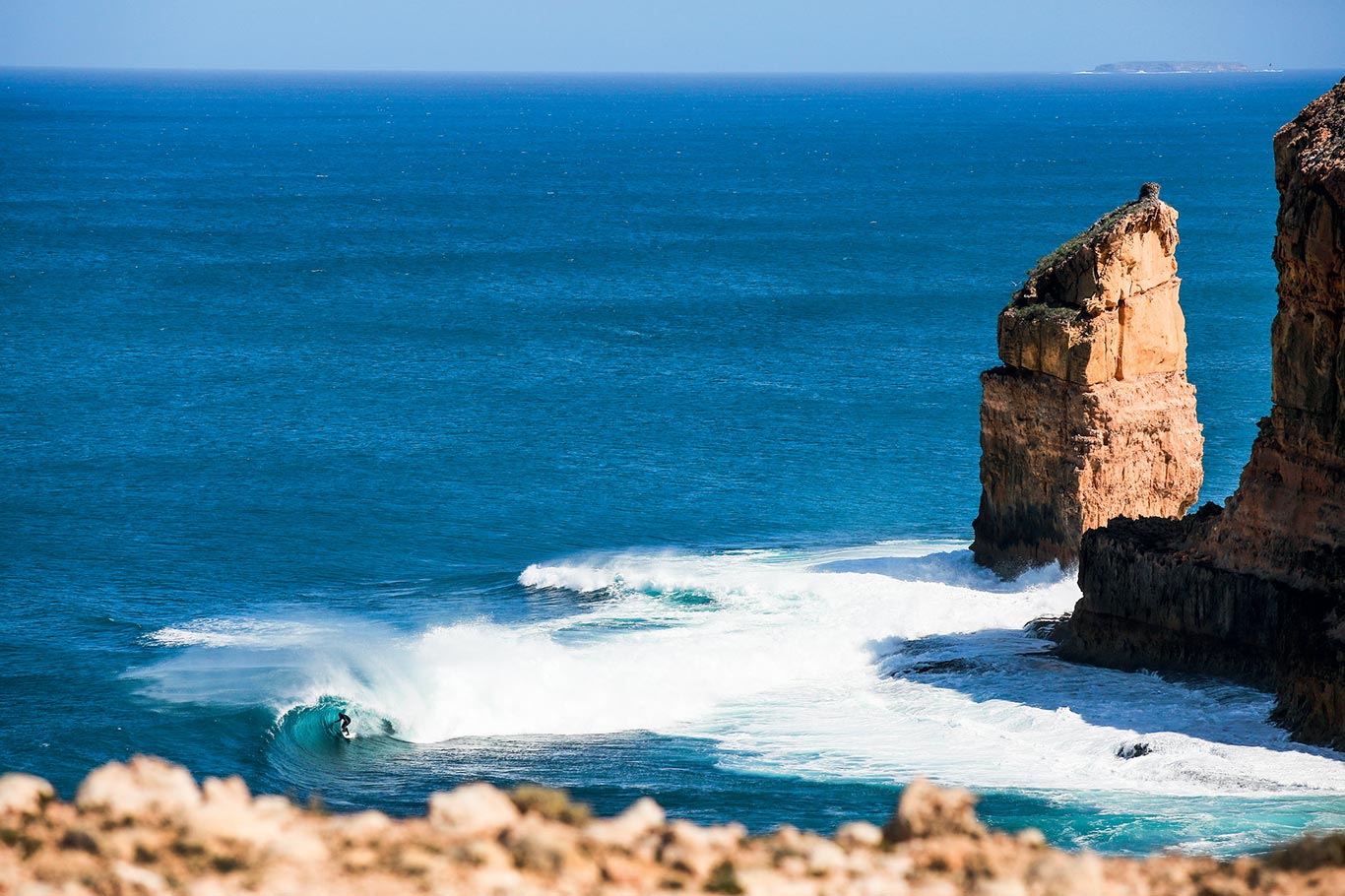
Pete Tomlinson is desert through and through. He’s also the man you’ll see below, sitting pretty inside one of the most visually spectacular spots you’ll find anywhere on the Australian coastline. Pete grew up in the unforgiving heart of the country that surrounds this wave and still lives in the area with his wife and two kids. With employment opportunities outside of fishing, shark tours and abalone diving few and far between, Pete earns his crust as a fly-in-fly-out worker in mining, where he aims to make a positive difference in a much-maligned industry by working with Australia’s traditional owners to ensure their Indigenous heritage is protected. “I work for a company called CHS – Cultural Heritage Services who contract us out to bigger mining companies like Santos,” explains Pete. “The traditional owners we work with do a ground survey for artefacts and areas of cultural significance that fall within a proposed mining area. Our job is to record and map these areas so they are protected from mining operations.” When Pete isn’t working he makes the most of the waves at home, and he’s doing a good enough job to maintain sponsorship by Billabong, Otis Eyewear & Stacey Surfboards. He’s got his routine worked out down to a fine detail and that’s just how he likes it. “Family, friends, work, surf, music and travel, that’s my life,” He enthuses. “A surf or two. A fish or a dive, beach with the family, fresh fish for dinner, a jam and a few beers with the boys – that’s a perfect day for me.” A perfect day was just what Pete had during the session you see pictured here. “The waves were amazing this day,” He recalls. “Perfect wind combined with the right size and swell direction for this wave. Three mates and I traded tubes all morning, had lunch at the shop and then went back for more tubes in the arvo.” While this all sounds like utopia unless you’ve got your wits about you, this part of the world can get the best of the unaware very quickly and it’s not just the heavy waves and environment to look out for. The tales of intimidating local regulation in this region are legendary, but Pete offers that if you’re smart, courteous and maybe a little lucky you could well enjoy the desert jewels on offer. “There are a bunch of … Read more

Pete Tomlinson is desert through and through. He’s also the man you’ll see below, sitting pretty inside one of the most visually spectacular spots you’ll find anywhere on the Australian coastline.

Pete grew up in the unforgiving heart of the country that surrounds this wave and still lives in the area with his wife and two kids. With employment opportunities outside of fishing, shark tours and abalone diving few and far between, Pete earns his crust as a fly-in-fly-out worker in mining, where he aims to make a positive difference in a much-maligned industry by working with Australia’s traditional owners to ensure their Indigenous heritage is protected.

“I work for a company called CHS – Cultural Heritage Services who contract us out to bigger mining companies like Santos,” explains Pete. “The traditional owners we work with do a ground survey for artefacts and areas of cultural significance that fall within a proposed mining area. Our job is to record and map these areas so they are protected from mining operations.”

When Pete isn’t working he makes the most of the waves at home, and he’s doing a good enough job to maintain sponsorship by Billabong, Otis Eyewear & Stacey Surfboards. He’s got his routine worked out down to a fine detail and that’s just how he likes it.

“Family, friends, work, surf, music and travel, that’s my life,” He enthuses. “A surf or two. A fish or a dive, beach with the family, fresh fish for dinner, a jam and a few beers with the boys – that’s a perfect day for me.”

A perfect day was just what Pete had during the session you see pictured here.

“The waves were amazing this day,” He recalls. “Perfect wind combined with the right size and swell direction for this wave. Three …

This is a Premium Feature only available to Tracks subscribers.

Existing Subscriber?  Login here.

The Making of Wanderlust

Nick Colbey racing through a large tube

Nick Colbey was always the ideal guy to direct this project because no one embraces the spirit of Wanderlust quite like ‘Cheese’. He has been known to hitch a hundred miles for a surf, drive borrowed cars interstate to play gigs for his band, Borneo, and catch planes across continents to go on a date. Fortunately, whilst pursuing his bohemian, rock-star existence, Nick still finds the headspace to be a curious and creative filmmaker. In the following interview, he discusses his philosophies on modern surf films and the spookiest moments from the making of Wanderlust. Why did you let go of pro surfing and go to film school? Did you feel like there was more scope or creative reward associated with pursuing a career in film production/directing? I don’t know if I was ever a “professional” or even close. I love getting tubed but my chodey legs never did too well above the water and in the air. I had a few comps that if I wasn’t such a nervous wreck I think I would’ve maybe done better. Surfing as a sport is pretty selfish. It’s all in your brain. I always thrived more at team sport I think. So I think a collaborative thing like making films was definitely more alluring than having a nervous meltdown in the round of 128 at a pro junior. I went travelling for a few years and ended up in Sydney between post pro junior pubescent years and adult, WQS-life-on-the-cards stage. I chose to go to film school instead of hitting the ’QS grind. Obviously a lot of kids dream of making surf films but do you think it’s important to have a broader understanding of the art form and the capacity to work in other areas? Definitely. I think you’ll make a better film the more you draw comparisons to the other films out there that make you tick. Even anything that’s inspiring in your ever day could help you create something you love and make it better. But I think it’s just getting out there with a camera and your mates and seeing through your concepts and ideas for surf movies. Every edit helps you broaden your final product. The director and his tools Wanderlust strives to be more than just a point and shoot, high-performance surf film. Why did you want to capture much more than just the surfing action? … Read more

Nick Colbey was always the ideal guy to direct this project because no one embraces the spirit of Wanderlust quite like ‘Cheese’. He has been known to hitch a hundred miles for a surf, drive borrowed cars interstate to play gigs for his band, Borneo, and catch planes across continents to go on a date. Fortunately, whilst pursuing his bohemian, rock-star existence, Nick still finds the headspace to be a curious and creative filmmaker. In the following interview, he discusses his philosophies on modern surf films and the spookiest moments from the making of Wanderlust.

Why did you let go of pro surfing and go to film school? Did you feel like there was more scope or creative reward associated with pursuing a career in film production/directing? I don’t know if I was ever a “professional” or even close. I love getting tubed but my chodey legs never did too well above the water and in the air. I had a few comps that if I wasn’t such a nervous wreck I think I would’ve maybe done better. Surfing as a sport is pretty selfish. It’s all in your brain. I always thrived more at team sport I think. So I think a collaborative thing like making films was definitely more alluring than having a nervous meltdown in the round of 128 at a pro junior. I went travelling for a few years and ended up in Sydney between post pro junior pubescent years and adult, WQS-life-on-the-cards stage. I chose to go to film school instead of hitting the ’QS grind.

O bviously a lot of kids dream of making surf films but do you think it’s important to have a broader understanding of the art form and the capacity to work in other areas? Definitely. I think you’ll make …

This is a Premium Feature only available to Tracks subscribers.

Existing Subscriber?  Login here.

Wanderlust: The final chapter – Part one

Mikey Wright pulls into a tube in west australia

Up North The Wanderlust convoy rolled into Perth on a soggy August morning. 4x4s jammed with boards and tents with no plans other than to get out of the city. From Perth surf trips can go two ways; Down South or Up North. It could have been a coin-toss to decide the first move, but the lads had a hankering to get way out into the wild so cars were pointed north and we took off up the highway for Kalbarri while keeping one eye on the forecast, watching for a Gnaraloo swell. Morning-time at the Kalbarri caravan park moves to the slow rhythm of the ablution block shuffle. The off-beat limp of grey-nomads with hip replacements sets the tempo. Past rows of shiny, shiny caravans perched on neat, terraced campsites the morning pilgrimage is made. Dress- ing gowns and Crocs are invariably worn. Luke ‘Louie’ Hynd and Mikey Wright lie oblivious in their slumber until the distant crack of breaking waves rouses them. Louie emerges from beneath his extraordinary mess of hair bleary-eyed but ready to take on the day. Mikey crawls out of his swag, shakes out his glorious mullet and sets an Akubra atop his head. ’Ow yer garn’ he greets the world. He looks and sounds like the postcard caricature of an outback Aussie. The salty old sea-dogs up on the point at Jakes don’t fall into the same stereotype. They’ve got long, straggly hair from a pre-Craig Ando-chic era and faces deeply lined from staring into a thousand sunsets trying to make out incoming swell lines against the horizon. They wear thrice-repaired Gaths and gaffer-taped wetsuits. They spout tomes of wisdom to anyone who’ll listen but we are wary of what to believe. ‘Junkyard’ Johnny, one of the more talkative salt-crusted masters, reckons the harsh weather drove all the soft people away. At first we are unconvinced because the wind is light and the sunshine pleasant. But it only takes a day or so for our burnt faces and bloodshot eyes to start screaming for relief. The first day in Kalbarri was the best on the forecast but Jakes was packed. The local community was celebrating the lives of two recently lost mates; Mason and Chad, by pushing themselves over the ledge on the craziest waves they could find. It was an emotional and personal occasion for the tight-knit community and Mike and Louie were … Read more

Up North

The Wanderlust convoy rolled into Perth on a soggy August morning. 4x4s jammed with boards and tents with no plans other than to get out of the city. From Perth surf trips can go two ways; Down South or Up North. It could have been a coin-toss to decide the first move, but the lads had a hankering to get way out into the wild so cars were pointed north and we took off up the highway for Kalbarri while keeping one eye on the forecast, watching for a Gnaraloo swell.

Morning-time at the Kalbarri caravan park moves to the slow rhythm of the ablution block shuffle. The off-beat limp of grey-nomads with hip replacements sets the tempo. Past rows of shiny, shiny caravans perched on neat, terraced campsites the morning pilgrimage is made. Dress- ing gowns and Crocs are invariably worn. Luke ‘Louie’ Hynd and Mikey Wright lie oblivious in their slumber until the distant crack of breaking waves rouses them.

Louie emerges from beneath his extraordinary mess of hair bleary-eyed but ready to take on the day. Mikey crawls out of his swag, shakes out his glorious mullet and sets an Akubra atop his head. ’Ow yer garn’ he greets the world. He looks and sounds like the postcard caricature of an outback Aussie.

The salty old sea-dogs up on the point at Jakes don’t fall into the same stereotype. They’ve got long, straggly hair from a pre-Craig Ando-chic era and faces deeply lined from staring into a thousand sunsets trying to make out incoming swell lines against the horizon. They wear thrice-repaired Gaths and gaffer-taped wetsuits. They spout tomes of wisdom to anyone who’ll listen but we are wary of what to believe. ‘Junkyard’ Johnny, one of the more talkative salt-crusted masters, reckons the harsh …

This is a Premium Feature only available to Tracks subscribers.

Existing Subscriber?  Login here.